Develop High-Quality Products Faster through Team Innovation

About the Author
Dianna Deeney is president of Deeney Enterprises, LLC and founder of Quality During Design. With over 25 years in manufacturing, product design, and quality engineering, she helps teams build dependable, user-focused products with less rework. An IEEE Senior Member and ASQ-certified quality professional, she hosts the Quality During Design Podcast and shares tools, training, and resources at DeeneyEnterprises.com.
About the book
National Indie Excellence® Award Finalist, Business – General
“Practical approach to carefully-researched, collaborative product design.” – BookLife Reviews (Publishers Weekly)
A playbook designed for professionals in product design, engineering, and UX.
- Align cross-functional teams for better collaboration
- Prioritize user experiences to avoid costly missteps
- Transform insights into actionable design inputs
Reviewed by the Product Development and Management Association
PDMA’s Chu Nnodu (Enterprise Product Manager, Ajared Research) reviewed Pierce the Design Fog, calling it a coherent system for “the work that most teams skip or rush.” Read the full review → https://www.pdma.org/page/review-pierce-the-design-fog
A proven framework to align teams, define clear design inputs, and accelerate product success.
In product development, great ideas can get lost in translation. Teams kick off with enthusiasm, but somewhere between the first design iteration meeting and the engineering handoff, misaligned assumptions lead to costly rework, stalled timelines, and products that miss the mark.
In Pierce the Design Fog, quality advocate and senior engineer Dianna Deeney reveals why 85% of companies struggle to get product development right—and how to fix it. Drawing from over 25 years in manufacturing, quality engineering, and cross-functional leadership, she shares practical methods for bridging the gap between concept development and engineering-ready designs.
Using her ADEPT Team Framework and Concept Space Model, Deeney provides a repeatable process to unite diverse perspectives, surface hidden requirements, and define clear, user experience focused design inputs. This hands-on playbook for managers, engineers, and product leaders uses step-by-step guidance, real-world examples, and ready-to-use templates to engage every stakeholder from the start and turn ideas into high-quality, customer-focused design inputs.
You will learn how to:
- Identify and avoid the “Ta-da Flop” by validating concepts before engineering begins
- Lead efficient, collaborative meetings that produce actionable design inputs
- Translate end customer user needs into prioritized, measurable requirements
- Apply quality engineering tools to reduce design loops and speed approvals
- Foster stronger cross-functional team alignment and earlier buy-in
If you lead engineers, market products, or manage cross-functional teams, Pierce the Design Fog will change the way you start projects— with results your customers will notice. Grab your copy of Pierce the Design Fog today, and take the first step toward effective innovation!
What people are saying about ‘Pierce the Design Fog’

Fred Schenkelberg
founder of Accendo ReliabilityThis book nails the hard part of product development: turning cross-functional knowledge into design inputs that actually ship.
Two ideas really stood out to me:
First, stay in the problem space and hold space for the team’s knowledge before you prototype. In practice, that means surfacing insights from ME/IE, quality, supplier development, and service before the organization hardens around an early concept. The payoff is real … fewer ECNs, cleaner DFMEA/PFMEA linkages, and less scrap at launch.
Second, run concept meetings, not status meetings, using ADEPT (Align – Discover – Examine – Prioritize – Teamwork). ADEPT separates exploration from commitment and gives ops, design, and finance a shared cadence for decision-ready learning. It dovetails with APQP and feeds better PPAPs, rather than creating more paperwork.
I received an advance review copy for free, and I am leaving this review voluntarily.
Deeney’s guidance is pragmatic. It respects capacity constraints, risk, and cost, which is exactly what today’s manufacturing professional lives with. If your goal is faster, higher-quality launches with fewer surprises, this is the playbook.

QualityGuy
Amazon Review
Greg Hutchins, PE CERM
author and evangelist of Future of Quality: Risk®Drew Boyd
Co-author of Inside the Box: A Proven System of Creativity for Breakthrough ResultsInnovation is not an accident—it’s the result of disciplined thinking, structured processes, and cross-functional collaboration. Dianna Deeney’s outstanding new book offers exactly that discipline in a form that is clear, accessible, and immensely practical.
As someone who has devoted his career to teaching systematic creativity through the Inside the Box method, I’m often asked how teams can better translate ideas into real, tangible value. The answer lies in what Dianna calls “concept development”—the critical bridge between initial idea generation and the technical execution of product design. This is the phase where ambiguity meets action. And it’s where success is most often won—or lost.
In this book, Dianna Deeney shines a light on the hidden levers of innovation success. She shows that the most successful projects aren’t those that jump headfirst into solutions. They are the ones that spend the time to fully explore the problem space, align team perspectives, and prioritize customer value before committing to design decisions. Her approach is rooted in decades of experience and it shows.
One of the core strengths of this book is its clarity of models and frameworks. The Concept Space Model, for instance, is a tool that helps teams navigate the complex terrain of user needs, benefits, and use processes. It goes beyond superficial user personas and instead provides a dynamic way to understand real experiences and opportunities for innovation. Likewise, the ADEPT Team Framework is a standout tool for running high-impact meetings. It helps cross-functional teams shift from fragmented communication to focused co-working—something every team needs more of.
Throughout the book, Dianna emphasizes that successful innovation is not just about creativity—it’s about alignment. Teams must share understanding, challenge assumptions, and embrace structure—not to stifle ideas, but to surface and shape them more effectively. She illustrates how traditional brainstorming often falls short and offers well-supported alternatives like brainwriting and visual templates. These are not trendy gimmicks; they are research-backed techniques that generate more and better ideas while enhancing team cohesion.
This book also pays due attention to the customer. With models like the Benefit-Impact and Symptom-Impact frameworks, Dianna helps teams connect the dots between user needs and design inputs. She shows how to prioritize features not based on internal preferences but on measurable impact to the user. And she does it all with a voice that is encouraging, practical, and full of empathy for the realities of product development.
What I admire most is how Dianna brings together disciplines that are often siloed—engineering, user experience, risk management, and design—and shows how they must come together to build products that work in the real world. Her treatment of use errors, task analysis, and even FMEA (Failure Modes and Effects Analysis) underscores the depth of her understanding while making these technical tools approachable to a wide audience.
The book is also refreshingly honest about the pitfalls of poor communication. Dianna points out that assumptions about shared knowledge are often the root cause of design missteps. By advocating for structured co-working and shared ownership of ideas, she creates a roadmap for collaboration that transcends titles and functions.
And while her frameworks are robust, they are also flexible. The book doesn’t prescribe rigid rules; it offers adaptable guidance that can be scaled to the complexity of any project. Whether you’re designing a medical device, a consumer app, or a piece of industrial equipment, these methods will help your team uncover what matters most—and act on it.
Dianna also shares the human side of her journey—acknowledging the mentors, colleagues, and family members who shaped her thinking. It adds warmth to what is otherwise a highly structured and technical guide. It’s a reminder that behind every product is a team of people trying to do their best work. This book helps them do just that.
In sum, this book is an essential addition to the product development literature. It’s rigorous without being rigid, structured without being stifling, and collaborative without being chaotic. If you’re part of a team trying to build something meaningful—and if you believe that understanding problems deeply leads to better solutions—then you’ll find immense value in these pages.
Dianna Deeney has created something important. She not only elevates the discipline of concept development, but she also equips teams with the tools to do it better, together.
Case Studies
When you develop concepts differently, engineering gets something rare: design decisions they can actually act on, with priority and context built in and no reverse-engineering required. These four case studies show exactly what that looks like.
Here’s why they’re a fair comparison: for each scenario, the same AI-driven cross-functional team worked through the same green-light packet. The only variable was the concept development process: traditional steps versus Pierce the Design Fog. Each product came with real constraints and conflicts embedded in the brief.
- Solar Installation Service — If you’re managing reputation and trust as a differentiator, this study shows how concept choices ripple through customer experience and brand.
- Portable Oxygen Concentrator — Medical device with safety, compliance, and liability woven through every decision. See how a different process surfaces the non-negotiables earlier and gives engineering what they need to design defensibly.
- Leafy Greens Harvester — Agricultural retrofit built for harsh field conditions. This case demonstrates how to keep productivity and reliability front-and-center when the environment is fighting you.
- High-End Smart Home Lock & Video Doorbell System — Electro-mechanical consumer product under margin pressure. Watch how concept choices either protect or erode profitability downstream.
The common result: engineering gets design inputs with priority, context, and action items. No ambiguity or rework.
Pick the case study closest to your project or your biggest pain point and see what shifts when the concept process changes.
Table of Contents
Introduction: Empower Teams to Develop Innovative Products
Part One
Master the Principles of Team-Based Concept Development
Chapter 1: Why Early Solutions Kill Innovation
Chapter 2: Unlocking Team Superpowers
Chapter 3: A Systems Approach to User Experience
Chapter 4: The Art of Using Models to Ignite Ideas
Chapter 5: Beyond Brainstorming
Chapter 6: Become ADEPT at Leading Meetings
Part Two
Practical Strategies for Co-Creating Powerful Design Inputs
Chapter 7: Explore the Concept Space
Chapter 8: Discover Customer Desires and Design Features They’ll Love
Chapter 9: Uncover Potential Problems and Design Products That Exceed Expectations
Chapter 10: Map the User Journey to Design Seamless Experiences
Part Three
Transform Shared Knowledge into Winning Product Designs
Chapter 11: Translate Customer Value into Concrete Design
Chapter 12: Engineer Resilience Through Symptom-Driven Design
Chapter 13: Eliminate Use Errors and Create User-Friendly Products
Publisher Details
Publisher’s Cataloging-in-Publication Data
Names: Deeney, Dianna, 1976- .
Title: Pierce the design fog : develop high-quality products faster through team innovation / Dianna Deeney.
Description: Kimberton, PA : Pin Gauge Publishing,2025. | Includes 64 b&w photos, diagrams, and charts. | Includes bibliographic references and index. | Summary: Provides a playbook for concept development with cross-functional teams, and introduces the Concept Space Model and ADEPT Team Framework to gather and prioritize design inputs. The work extends these methods to translate early knowledge into concrete design specifications, informing later stages like risk analysis and usability.
Identifiers: LCCN 2025914027 | ISBN 9798989325931 (hardcover) | ISBN 9798989325900 (pbk.) | ISBN 9798989325917 (ebook) | ISBN 9798989325924 (audiobook)
Subjects: LCSH: New products – Management. | Product design. | User-centered system design. | Cross-functional teams. | BISAC: TECHNOLOGY & ENGINEERING / Industrial Design / Product. | TECHNOLOGY & ENGINEERING / Systems Engineering. | TECHNOLOGY & ENGINEERING / Technical & Manufacturing Industries & Trades
Classification: LCC TS171.D44 2025 | DDC 658.5 D–dc23
LC record available at https://lccn.loc.gov/2025914027
Book Excerpt
Introduction: Empower Teams to Develop Innovative Products
Anyone can use their creativity to design products, and we should! To manufacture high-quality products, we need a skilled team.
Product designers and design engineers in the industry connect ideas to finished products. They combine artistic vision with technical expertise. They figure out how to make products. Their goal is products that are appealing, user-friendly, efficient, and safe.
Designers don’t work alone. Successful new product development requires a design concept that is developed early by a cross-functional team. A cross-functional team includes members from different functional groups within the company. These teams usually involve engineering, design, marketing, sales, and manufacturing.
Teams typically do not communicate well during concept development.
In his book Winning at New Products, Robert G. Cooper writes, “High-quality and effective cross-functional teams are at the heart of any well-executed project.” It’s a key factor that underlies success. In terms of its impact on new product performance, it correlates to profitability and timeliness, in both how fast the project was done and if it launched on time.
Cooper also cites studies that show projects are more than three times as likely to succeed with “sharp, fact-based product definition before development begins.” Projects have 2.5 times the success rate and earn double the market share if the team does “solid up-front homework” doing front-end activities well. These activities include the fuzzy front-end and precede the development phase. This is when the market and product are defined.
However, many teams do not undertake these types of predevelopment activities or perform them to the level they should. Cooper shows that only 16% of person-days on a project is dedicated to early work. He writes, “In too many projects, we observed a new product idea that moved directly into development with very little in the way of up-front homework to define the product and justify the project – a ‘ready, fire, aim’ approach.”
Teams move ahead into product development without customer requirements or customer input. Comparing successful products to failed products, successful ones have about 75% more time dedicated to these pre-development activities.
Little development or knowledge sharing occurs between people on a project, especially in these early phases. This results in information getting lost in translation or simply getting lost, leading to challenges in meeting the customer’s wants or needs.
Misunderstandings happen.
Teams lack clear communication with designers, sometimes assuming shared knowledge. With good intentions, functional groups swap information about a new idea or opportunity they feel is complete. Even if they are done well and are thorough reports, a hand-off introduces the possibility of misinterpretation.
Others cannot easily translate the information into design. Or there are several assumptions that need to be made to jump from idea to design, and assumptions can be wrong. The information from each group is disjointed and may conflict. The designers don’t know what clarifying questions to ask the team.
Designers just accept the information and move on to designing a solution without first developing concepts with their team.
When I ask development team members about their challenges, I hear this frequently: “We started a project with all the market and customer research we were supposed to do. Then, we handed it over to engineers to develop. They came back with something that we didn’t want, and customers don’t like!”
I also talk with engineers, and I can understand their point of view, too. “We were given all this information and had kick off meetings. We understood the problem and actually found a solution! We had to make trade-off decisions and ensure manufacturing could make it. We spent a lot of time coming up with this creative solution, and they didn’t even appreciate it!”
Teamwork can be difficult.
Another reason concept development is difficult is because of challenges with teamwork. Many people believe individual work is superior to teamwork in terms of speed and efficiency—and that more participants lead to wasted time and poorer decisions. As a result, the team leaves designers out of concept sessions. Or designers decide to work alone with what they know.
These decisions can get teams stuck in a loop.
Despite the challenges, cross-functional collaboration has its advantages. We’re pulling together people with diverse mindsets from across the organization to work together on a single idea. While we have different perspectives on the same problem, those perspectives can help us create a better product.
Leadership can help with challenges, like defining goals and aligning performance metrics to those goals. If leadership doesn’t provide that guidance, teams can help themselves by establishing shared objectives: understanding users, their environment, the product’s purpose, and company objectives.
It’s not enough to just share the information. Teams need to explore it together and move ideas toward design inputs they prioritize. Designers must co-work with their cross-functional team before they create solutions. A key aspect of this teamwork is holding space for their team to share their knowledge.

Thank you for reading!
If you enjoyed Pierce the Design Fog, please leave a review on Goodreads or on the retailer site where you purchased this book.
Ask PTDF: Your AI Study Companion

Ask PTDF is an AI chatbot trained on Pierce the Design Fog frameworks. Ask questions about ADEPT, Concept Space Model, symptom analysis, prioritization…anything you need clarified as you apply these methods to your work. Get quick answers grounded in the book, with pointers to relevant chapters for deeper reading.
Important: AI systems can occasionally misinterpret or oversimplify. Always verify important concepts against the book. For detailed explanations, case studies, or professional guidance, refer to the full text or contact us directly.
About your email: We use it to manually review your questions and reach out if we think we can help with workshops or other resources. No automatic list additions. Newsletter signup is always optional. Prefer to reach out directly? Email [email protected] or visit Dianna’s contact page: deeneyenterprises.com/contact.
Welcome to Our Chat!
Let's get started. Enter your email to begin chatting with us.
Companion Card Deck – Expert at your Elbow

You’ve read the book and are ready to start. Like many new things, you may still feel nervous you’ll lose your way. Facilitating may be new to you, and you want this to be a great experience for your team, so they’ll join you again and again.
Use this handy card deck as cheat sheets while you’re planning and facilitating. These cards supplement the methods in the book. Each suite guides you through the steps to take with your team to develop concepts.
Take out the suite related to the focus you’re working on. Use it to plan. During the meeting, expose each card as a reminder of what you’re guiding the team to do. They’re discrete and easy to read, like an expert at your elbow guiding you through new skills.
Stuck with prioritizing? Share some of the cards with your team so they are on the same page with how to rate and prioritize impacts and use steps.
Together with the book, you’ll be well on your way to concept development and design inputs that matter!

Related Podcast Episodes
These seven episodes of the Quality during Design Podcast make up a series that introduces and explores the ideas in Pierce the Design Fog. They’re another way to bring the book topics to life so you can apply them. They’re listed in order as they appear in the book:
Media Mentions

Pierce the Design Fog Named Finalist in the National Indie Excellence Awards
June 11, 2026
Pierce the Design Fog has been named a Finalist in the Business – General category of the 2026 National Indie Excellence® Awards (NIEA). The announcement came as part of the NIEA’s 20th annual competition, marking two decades of the organization recognizing standout work from self-published authors and independent presses.
The NIEA evaluates submissions on both content and production quality, with a jury of publishing professionals, including authors, editors, and designers, reaching consensus on each category’s winner. Being named a finalist places Pierce the Design Fog among a small group of standout titles selected from a competitive field.
View the 20th Annual Finalists → https://www.indieexcellence.com/20th-annual-finalists
BookLife Reviews (Publishers Weekly)
“Practical approach to carefully-researched, collaborative product design.”
The review noted that Pierce the Design Fog “capably breaks [complex ideas] into digestible steps,” and closes by calling it a workable approach to bridging the gap between product idea and engineering design.
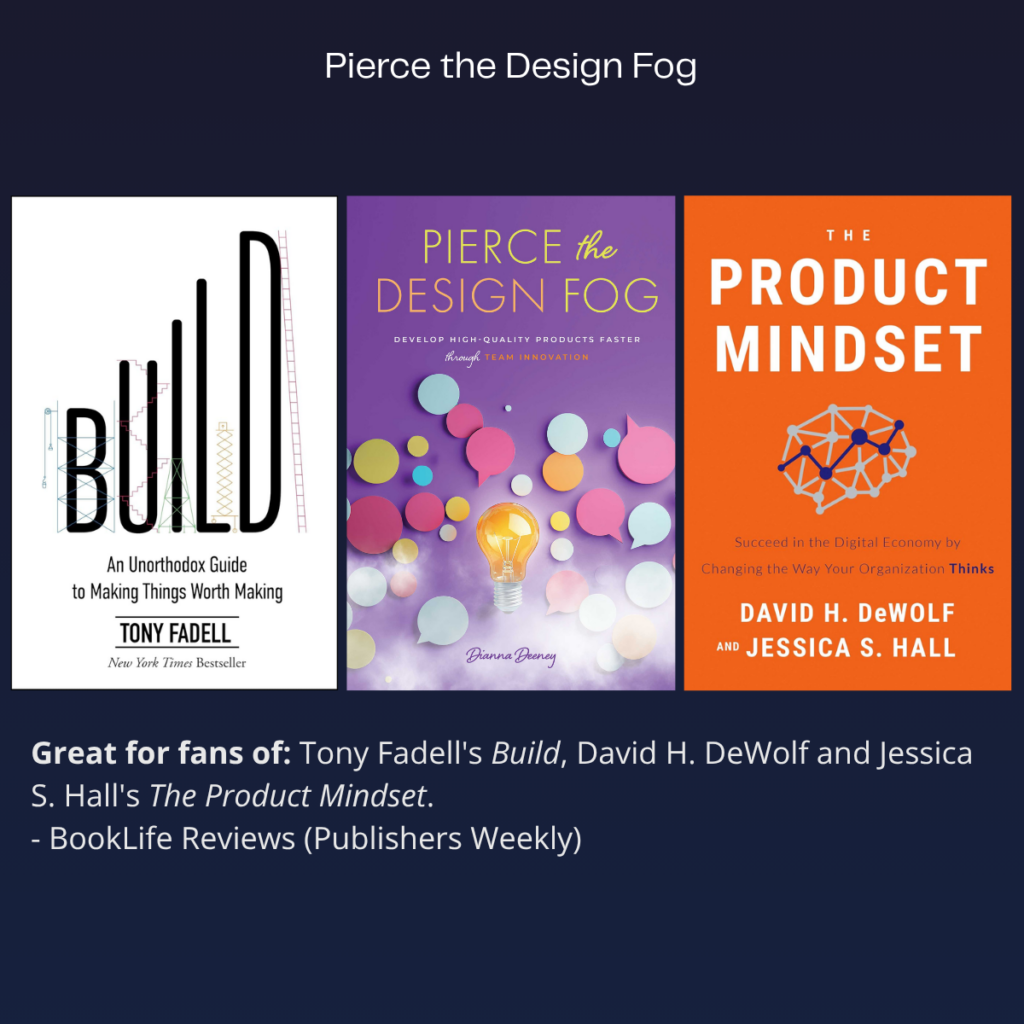
Great for fans of Tony Fadell’s Build and David H. DeWolf and Jessica S. Hall’s The Product Mindset.
Contact the Author
For contact information, including for consulting and other services, visit Contact Information for Deeney Enterprises
Follow Dianna on LinkedIn: www.linkedin.com/in/diannadeeney
Book Dianna Deeney for interviews or speaking at [email protected] or visit DeeneyEnterprises.com.
Want bulk ordering options?
Interested in buying 10 or more copies? Contact us for our discount schedule: [email protected] or visit www.pingaugepublishing.com.